



站點(diǎn)地圖

The list of "Top Ten Contemporary Chinese Buildings" led by the China Architectural Culture Research Association of the Ministry of Culture and other units has just been released. We don't say which buildings they are, but you can definitely guess one or two, such as Jinmao Tower, Shanghai Center, Xiaomanyao Guangzhou TV Tower, Bird's Nest, right! CCTV Building, NO, is too ugly, too challenging to the visual bottom line, and has some parody meaning, so it was not selected.

The design inspiration of Shanghai Center, whose architectural shape rotates, changes and spirals upward, is rooted in traditional Chinese culture (picture from the Internet)
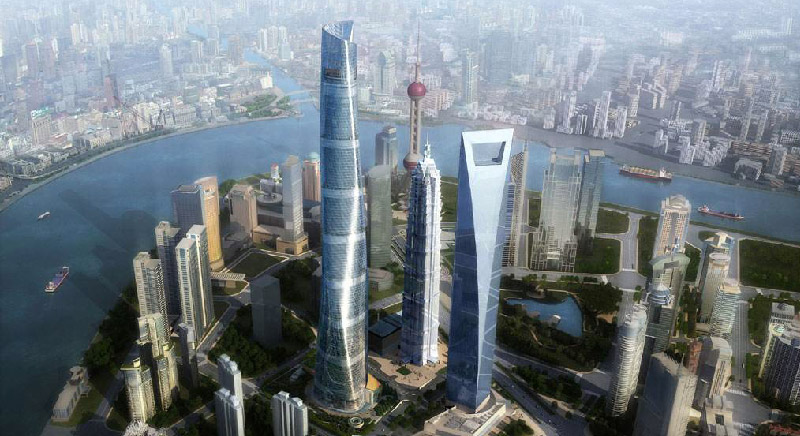
The 632-meter-high Shanghai Center will become a new milestone in the history of Shanghai's high-rise buildings. (The renderings are from the Internet) The selection is very "third-party"
The background for the selection of the top ten contemporary buildings is of course new urbanization. "Urban construction should reflect the concept of respecting nature, conforming to nature, and harmonizing man and nature, relying on the unique scenery such as the existing landscape, so that the city can be integrated into nature, so that residents can see the mountains, see the water, and remember homesickness."
But the reality is that after the founding of the People's Republic of China, learning from the big brother of the Soviet Union has become an inevitable choice for China under the severe international situation, so a large number of Soviet-style buildings have been copied in Chinese cities. This is the era of "revolutionary architecture" that has dominated the appearance of Chinese cities for 40 years.
Entering the 1990s, Chinese urban architecture began to show a diversified development trend. Before the 2008 Olympic Games, the mainstream architectural forms that affected Chinese cities were "Wushaomao". When you walk along Chang'an Avenue, you can see: Chinese-style large roofs and Bauhaus-style main structures, that is, state agency buildings; The other category is the "experimental field"-large-scale public landmark buildings represented by the works of international architectural masters such as "Bird's Nest" and "Big Pants". In addition, there are marginal art, international style and avant-garde all kinds of strange design wisdom in this big construction site in China.
In view of these realities, the organizers are not looking for the government or developers, but for authoritative scholars and opinion leaders in the fields of architecture, culture, professional media, real estate and social networks. Judging from the composition of the judges and the final results of the selection, the "Top Ten" are quite typical and universal. Of course, the consideration of artistic aesthetics is also very cautious.
The Naturality of the Top Ten Buildings
The top ten buildings newly released in June this year are: China Zun, Bird's Nest (National Stadium), Central Park Plaza, Xiangshan Campus of China Academy of Fine Arts, Shanghai Jinmao Tower, Taipei 101 Tower, Xiaomanyao (Guangzhou TV Tower), International Trade Center Phase III, Shanghai Zendai Himalayan Center, Shanghai Tower.
The buildings built by western architects are the best, that's for sure. Buildings such as Jinmao, Bird's Nest, Guangzhou TV Tower, Zendai Himalaya, Shanghai Center, and China World Trade Phase III are all hired by international design names. The tower has a special position in the heart of Chinese people, so although SOM is an American company, it still designed the Jinmao Tower with the image of the tower; Although the Bird's Nest designed by jacques herzog is not an energy-saving building (the entry "Energy-saving Building" is provided by the industry encyclopedia), it is not a material-saving building, but it is generally accepted because the thick steel-like "nest" coincides with the idea of "home" of ordinary people; The Guangzhou TV Tower designed by mark heimer and his wife is affectionately called "Xiaoman Waist" by Guangzhou citizens, just like "Cherry Fan Sukou, Willow Xiaoman Waist" sung by Bai Juyi, swaying along the Pearl River. I wonder if heimer and others have studied Bai Juyi's poem?
Isozaki Shinzo, the designer of Zendai Himalaya, carried out the "artistic temperament" to the end. From a distance, it looked like a square structure, and when approaching the front, it was an "alien forest". In Isozaki Shinzo's eyes, the Himalaya Center was not a simple building, but a sculpture and a work of art. Especially the "alien forest" continuously spreads the rendering power of art to the whole building from its appearance and connotation, making the charm of the whole building grow with the alien body. In Isozaki's new design concept, "Hetero-shaped forest" is like a "forest" naturally grown from the ground. The hetero-shaped part should be rich in texture and natural, rather than deliberately decorated.
Taipei 101 was designed by Chinese Li Zuyuan. In my impression, he is the only Chinese designer in the forest of high-rise buildings over 500 meters in China. Li Zuyuan designed this Chinese-style skyscraper with a talented image (the entry "Skyscraper" is provided by the industry encyclopedia), which is stable and atmospheric and has the meaning of sesame seeds blooming steadily. People are full of joy when they see it.
The Coexistence Relationship of "Chinese Taste"
Although SOM is very powerful, three of the top ten buildings (Jinmao Tower, Shanghai Center, and International Trade Phase III) were built by them, many people still like things designed by the Chinese themselves, like Li Zuyuan. Although Li Zuyuan later designed the Famen Temple Namaste Stupa is quite controversial, but we like the "talented" 101. Wang Shu's Xiangshan campus is also famous: "The mountain determines the scale of that house, and that house is like a tree planted on the side of the mountain." "Folk houses are the most popular form of architecture, but at the same time they also carry the soul of a country or national architecture. It can be said that, There are not many designers in contemporary China who can so deeply and closely link avant-garde creative styles with ancient folk traditions as Wang Shu. "The commentator said.
"The relationship between Chinese mountains and buildings has never been a landscape relationship, but a kind of coexistence relationship. Looking at the tower from the outside, the dense eaves and tiles press the tower color, the eaves are very thin, the materials breathe with the mountain, and the tower is like being sucked in the middle of the mountain. In the foggy aura like a mountain, the tower is even completely hidden and becomes very light. At that moment, I understood the possible facade practices of huge sloping roof buildings, a facade with internal and external permeability, and the lightness and concealment of the tower made me see the road home of Xiangshan campus, "Wang Shu said.
But Wang Shu is not "simple and traditional". He is interpreting Chinese architectural tradition in his own way, like Xiangshan Campus. "What he shows is not a building, but an impression. Dreams are the second kind of life, as if half-open eyes are watching something. Sometimes, when we are half asleep and half awake, we see them, We want to catch them, define them, and then we wake up, and they run away... Just like the early spring morning fog in the south of the Yangtze River, we'shake 'the scenery with our half-open and half-closed eyes, unable to define the clearChu the shape of any object. "
(Excerpted from China Curtain Wall Network)